Cracks and nail pops
Hairlines climbing from door-frame corners and little bumps marching down a stud, the marks of an older house settling.
Crack repair detailsCamden County walls and ceilings
Settling cracks, popped nails, leak-ringed ceilings and doorknob or remodel holes, rebuilt and textured so the mended spot sits quietly in the wall, then handed back ready for your paint.
Call 7 days, 7am–9pm
Describe it on the call; the pro who'd take the job names a figure before a single screw comes out.
Sending okays a text or phone call about this wall from Bellmawr Drywall Repair itself, or from the local pro pricing it. Privacy
Next, a Camden County drywall pro gives you a ring, hears the details and puts together your figure.
Cracks and nail pops
Hairlines climbing from door-frame corners and little bumps marching down a stud, the marks of an older house settling.
Crack repair detailsCeiling water stains
A tea-colored ring beneath the upstairs bath or a spongy spot after a storm, opened and rebuilt once dry.
Ceiling leak stepsHoles and remodel cut-outs
Doorknob punches, ripped-out anchors and the square a plumber sawed open, closed over solid backing.
Hole patching options
Gypsum dust is fine and drifts. A bit of setup confines it to one room. Below is what a careful job puts in place beforehand, and what to raise when the pro rings you about pricing.
Canvas or heavy builder's paper runs along the base of the wall, its seams taped so nothing shifts underfoot. Pieces within arm's reach get slid toward the room's center and draped. You can help by emptying nearby shelves and lifting frames and lamps out of the way the evening before.
Registers and cold-air returns close to the work get covered in plastic, and the furnace or AC usually sits idle during sanding. Otherwise the ductwork carries grit into bedrooms. Next: locate your thermostat so it can be paused for an afternoon.
Plastic sheeting fitted with a zip opening can seal off the work area. Overhead jobs call for more covered floor, because ceiling dust drops and then wanders. In a room with two doors, decide which one stays usable.
Sanding heads hooked to a dust extractor, or wet-sponging the final coat, slash airborne grit. Asking which method will be used is perfectly fair before anything is booked.
Older Bellmawr drywall tends to need one of these four kinds of help. Begin with whichever card matches what you're staring at.
Seam lines, diagonal splits above doors and fasteners poking through paint, bridged with tape and refinished to resist reopening.
Rings, drooping panels and mushy patches traced to a tub, toilet, roof or condensate line, removed to firm gypsum and rebuilt.
Finished downstairs walls that drank up floodwater, trimmed off at a level line and closed with damp-tolerant board.
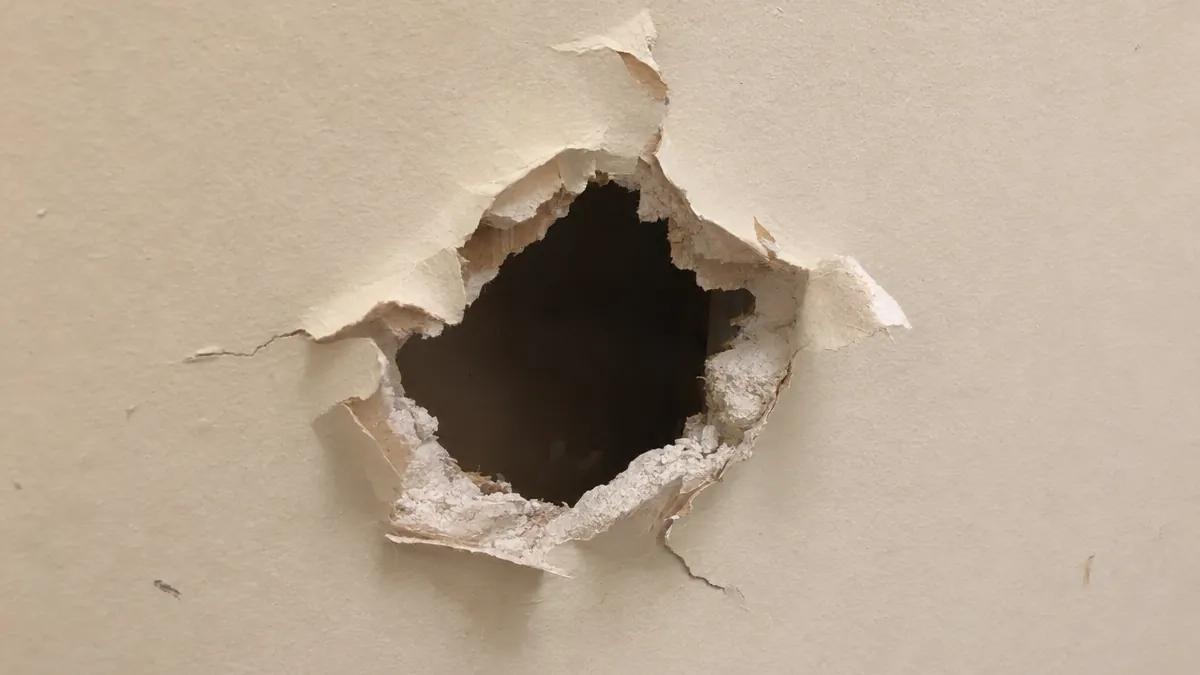
Doorknob craters, impact holes and the access openings electricians and plumbers leave, backed, taped and textured.
Prefer an overview? See all four repair pages side by side.
Most wall-repair doubts boil down to appearance, calendar and mess. Tap any question.
In most rooms, yes. Orange peel, knockdown and smooth finishes are each rebuilt by their own method, and trying the texture on a scrap of board first is sensible. If you remember how the walls were originally finished, pass that along.
It is. One hole is plenty of reason to call. Folding the other dings and anchor scars in the house into that same quote gets more done in one go, so tour the rooms with a notepad before calling.
Sanded flat and sealed with primer, a patch absorbs paint at the same rate as its surroundings, so it is much harder to pick out. Flat paint hides repairs better than satin or gloss. Rolling the entire wall, corner to corner, evens everything out best.
Expect at least two for most jobs. Joint compound is applied in several thin layers, and every one needs its own drying interval. Anything that got soaked must dry out before replacement board is hung, which stretches the calendar a little.
There is some dust, mostly from sanding the final layers. Floors covered, vents sealed, and dust-extracting sanders or wet-sponge finishing on the final pass keep most of it beside the wall. A run with your vacuum afterward takes care of the rest.
A leak dumps several worries on you together. Sorted into a sequence, each piece is doable, and the gypsum itself comes last rather than first.
Turn the little valve behind the toilet or under the sink, or close the house main, then hunt down where it started: an upstairs tub, a supply hose, roof flashing or an AC drain. That source has to be dealt with before anyone decides about drywall.
First stop is the electrical panel: switch off whichever breaker powers the overhead fixture closest to the swelling. After that, move kids and pets well away from the swollen area and park a bucket plus old towels underneath. Should the board start splitting, or the belly keep growing, leave the room and phone.
Prop doors open, aim box fans at the damp area and run a dehumidifier. Camden County sits in a humid climate zone, so in summer that dehumidifier carries most of the load. Then be patient: soaked gypsum feels dry to the fingertips long before its core has let go of the water.
A pin-type meter shows whether panels and the studs or joists behind them are truly dry. Gypsum that stays damp, crumbles at its edges or smells of mildew has to go. Panels that harden up again can frequently stay, once they get a coat of stain sealer.
Mushy gypsum, sodden insulation and any moldy section are removed until firm board and framing show. Fresh drywall is then screwed up, taped and finished. Read how a leaking ceiling gets rebuilt, or what becomes of water-damaged drywall in a lower level.
Five minutes spent on this makes that first conversation painless. A cellphone and a tape measure cover all of it.
Bellmawr fits into 3.11 Camden County square miles, with I-295 and the North-South Freeway meeting inside its limits. Jobs are scheduled throughout the borough and in each municipality sharing its boundary.
Next step: open the town-by-town notes.
Between 1940 and 1960 Bellmawr's head count jumped from 1,250 to 11,853, and its streets reflect that boom. Of the 5,016 homes standing now, Census figures place 1,431 in the 1950s and 1,502 in the 1960s, more than half in total. Walls from that era behave in predictable ways.
Homes of that vintage might have first-generation drywall, gypsum lath topped with plaster, or a patchwork where certain rooms got redone. Each wants a slightly different patch. Snap a picture of the broken edge; it reveals which one you're dealing with.
Generations of summer swelling and winter shrinking leave hairlines at door and window corners and along ceiling joints. Most are skin-deep. One that keeps widening, or that shows up alongside binding doors, deserves a framing look before anyone patches it.
Close to nine in ten Bellmawr homes, 4,494 of 5,016, predate 1980. Old layers underneath today's color could hold lead. Federal EPA rules govern paid jobs disturbing paint in pre-1978 housing, so before sanding begins, ask how the pro handles lead-safe practices.
According to Census estimates, renters occupy 1,745 of Bellmawr's 4,873 occupied homes, roughly a third. Turnover season is when small wall damage piles up, and some planning keeps the vacancy short.
Tour the empty unit with a notepad, logging every hole, anchor tear, crushed corner and raised screw head. A single quote covering the lot is simpler to schedule than a string of tiny ones. Then send that list along with one picture per spot.
Mention an occupied unit up front, plus the days your tenant can allow entry. Scheduling can then follow their calendar, and the affected rooms can be emptied beforehand.
Repairs wrap up primed, or at least ready to accept primer, letting your painter roll the whole unit straight afterward. Share the paint brand and sheen you use so every patch takes it evenly.
Under EPA rules, owners of pre-1978 rental housing must use lead-safe practices whenever work disturbs paint. Give the building's construction date on the phone and ask what that means for your job.
None of these stages is big alone. Here is the sequence they follow.
Phone, use the short form above, or message over a shot of the damage.
A nearby pro who does drywall rings back, asks a few questions about the wall, and arranges pricing.
The figure and the scope arrive before any cutting, patching or sanding. Then the choice is yours.
Board, tape and several thin coats of compound, each given time to set up.
Texture blended in, then primer, leaving a surface that wants only your paint.
There is more on what happens between your first message and a primed wall, and on which small fixes you can handle yourself.
Size reshapes the job more than any other factor: how many coats, how long drying takes and how much texture needs rebuilding. The dollar figures here come from This Old House's 2026 drywall pricing article and reflect nationwide averages, not Bellmawr; your quote rests on the actual wall.
One or two coats, then sanding. That article pegs a professionally fixed 2-inch hole near $60 to $100, and crack work around $60 to $330 depending on length.
Expect a backed patch, tape and usually three coats with hardening time between them, so the work stretches past one day.
Replacement board gets fastened to studs or joists, then taped, coated and textured. For bigger areas the article cites a square-foot rate of roughly $50 to $80, and $320 to $1,300 for a hole in a ceiling.
Overhead work, heavy texture, cramped access, soaked framing that needs drying, and whether paint is in the quote. A plumber or roofer fixing the source bills separately. Next step: send a photo so pricing starts from your real wall.
Knowing what a normal mid-repair wall looks like makes the in-between days easier to live with.
Compound sets layer by layer, so most repairs spread over two or more days. Muggy air slows the setting, and South Jersey summers run muggy. Keep the room clear for those days and the wait stops feeling long.
Until primer goes on, a patch stands out: a different shade, maybe a faint ridge at the edges before the last coat gets feathered. That is simply what the halfway point looks like.
Work ends textured and primed, or prepped to accept primer, so you or your painter can finish. Dabbing paint on the patch alone may leave a halo visible in raking light; repainting wall-to-wall evens things out.
Low sidelight exaggerates small ripples on any wall, patched or original. A well-feathered repair reads as flat from normal viewing distance, and flat paint helps further.
One snapshot and a sentence are plenty to begin. Ring, text a photo, or fill out the quote form.
Your first move is a call, and the local pro's figure arrives before any board gets touched.